Drone Competitions in Education: Building Coding, Engineering, and Career-Ready Skills
A drone competition hands students a real problem and does not let them fake the answer. Teams program and pilot a small drone through timed, judged missions, so the work only counts when the code runs, the build holds together, and the team communicates under pressure. At iDESIGN Solutions, we help US schools, districts, and CTE programs bring drone competitions into classrooms and after-school programs, and we see how fast students move from watching a demo to building something that flies. This guide explains how educational drone competitions turn coding, engineering, problem-solving, communication, and teamwork into skills that carry into real careers, what the federal data says about those careers, and how to start a program with confidence.
Key Takeaways
- Drone competitions in education run four judged missions students program and pilot, turning coding and engineering theory into applied, career-ready skill.
- STEM jobs are projected to grow 8.1% from 2024 to 2034 at a $103,580 median wage, versus 2.7% and $48,000 for non-STEM work.
- The FAA projects nearly 95,000 new remote-pilot opportunities by 2029, as registered commercial drones climb from 966,000 toward 1.18 million.
- Students program the CoDrone EDU in Blockly and Python; the Aerial Drone Competition is recommended for ages 10 to 18, in teams of 3 to 5.
- Schools generally fly under FAA Part 107 unless chartered by a recognized Community-Based Organization, and any drone 250 grams (0.55 lb) or heavier must be registered.
- Start small: pair a CoDrone EDU classroom pack with a field kit and a safe practice arena, then register one team for the current season.
What Is a Drone Competition in Education?
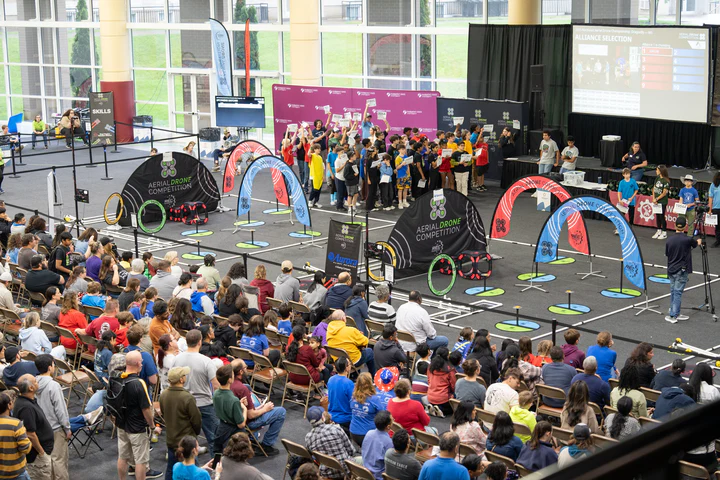
A drone competition in education is a structured STEM program where student teams write code and pilot a small drone through a set of standardized missions, then get scored on both how the drone performs and how well the team documents its work. The most widely used example in US schools is the Aerial Drone Competition, run by the Robotics Education & Competition Foundation, which is recommended for students ages 10 to 18. It runs as a full program across a season rather than a one-time activity, which is what makes it stick as a way to teach.
The Four Missions: Teamwork, Autonomous Flight, Piloting, and Communications
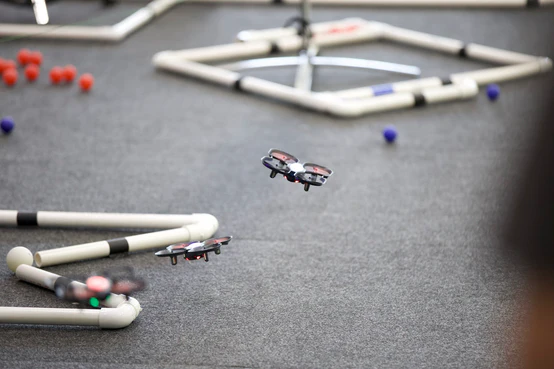
The competition is built from four missions, and each one asks for a different skill. Two of them are flown live, one is coded to run on its own, and one is a face-to-face interview with judges about the team’s work. That last mission is where the Competition Logbook matters, because students have to explain their drone, their programming, and their design decisions out loud, the same way an engineer defends a project at work.
| Mission | What students do | Skill it builds |
| Teamwork Mission | Two teams fly on the same field at the same time to raise a combined score | Collaboration and shared strategy |
| Autonomous Flight Mission | Program the drone to fly the mission with no pilot input, then score on its own | Coding and logical problem-solving |
| Piloting Mission | Fly the drone by hand through an obstacle course for points | Precision control and focus |
| Communications Mission | Interview with judges about the drone, the code, and the logbook | Technical communication and documentation |
Why Competitions Turn Coding and Engineering Into Real Learning
Competitions work because they replace an abstract lesson with a physical challenge that only succeeds when the code, the build, and the team all hold up together. A student can guess on a worksheet. A student cannot guess a drone through an autonomous mission. This is applied learning in the sense the US Department of Education uses when it promotes work-based learning as an instructional strategy, connecting classroom instruction to the kind of task a person actually does on the job. The competition gives students a reason to care whether their code is right, because the drone answers back in real time.
Here is how the five skills in this program map onto the work students may do later. This is the throughline we point to when educators ask what a drone team is really teaching.
| From the competition floor to a career skill | |
| Coding a mission in Python | → writing and debugging software that has to run correctly the first time |
| Running the build, test, and debug loop | → the engineering design process used in every technical field |
| Solving a mission under a time limit | → troubleshooting a real system when something stops working |
| Defending the logbook to judges | → presenting and documenting technical work for a team or a client |
| Splitting roles across a team of five | → collaborating on a project where no one person owns every part |
Coding: Programming a Drone From Blockly to Python
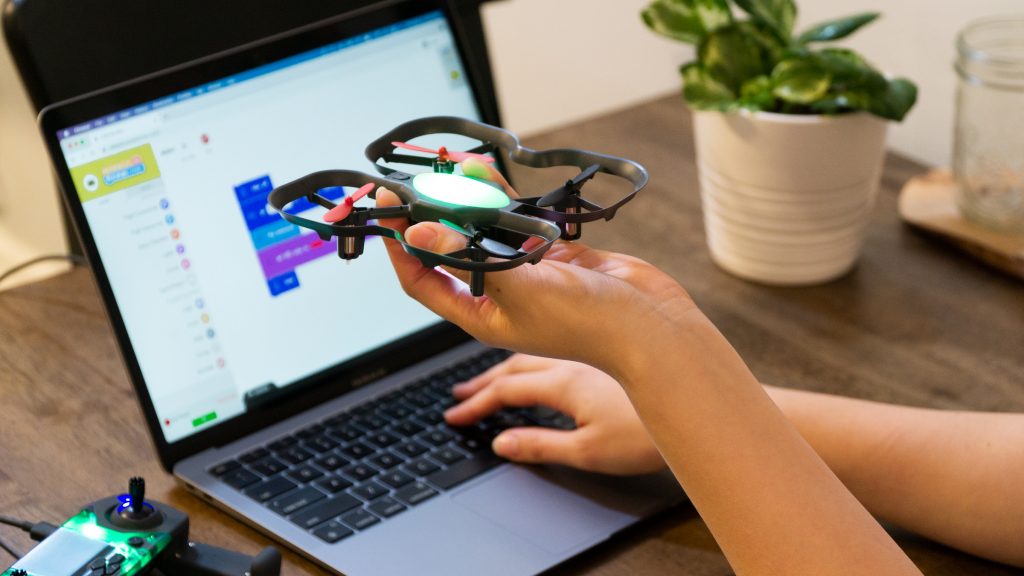
Students code the drone in two languages on the same platform, which is what lets a beginner and an experienced coder sit on the same team. On the CoDrone EDU, newer students start in Blockly, a block-based language where they drag commands together, then move into Python, a text-based language used across the software industry. The autonomous mission is where this becomes real, because the drone flies whatever the students wrote. If the logic is off, the drone misses the target, and the team goes back into the code to find out why. That feedback loop is the whole point.
Engineering and Problem-Solving: The Build, Test, and Debug Loop
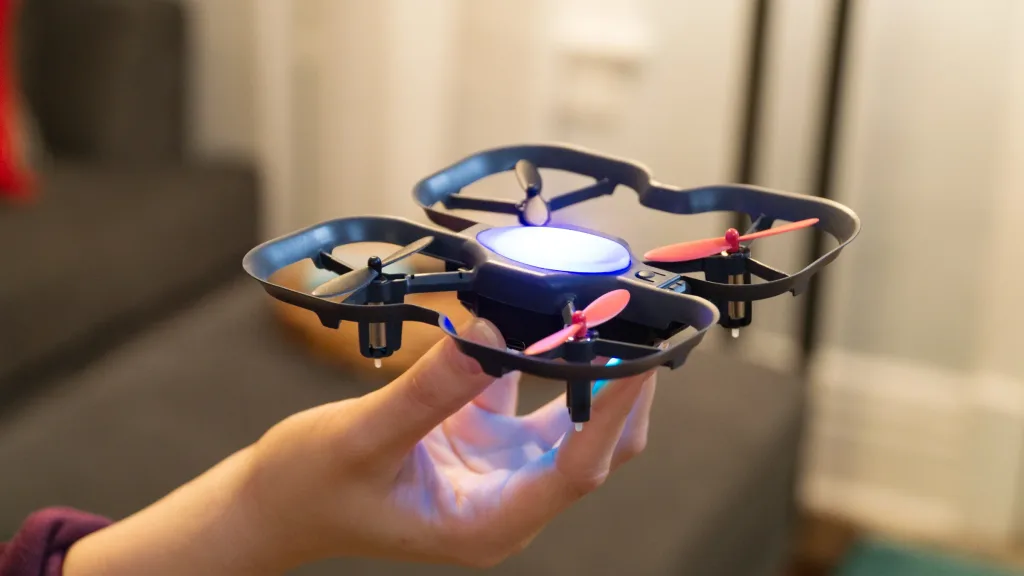
Getting a drone to complete a mission is an engineering problem, not just a coding one. Students work with the drone’s onboard sensors, including range sensors for detecting obstacles and the ground, a color sensor, and an optical flow sensor for position, and they have to reason about why the drone did what it did. A run that fails is information. Teams change one thing, fly again, and watch what happens, which is the same build, test, and debug loop that engineers run every day. The Competition Logbook captures this process, so students learn to record what they tried and why, not just what finally worked.
Communication and Teamwork: The Skills Employers Ask For
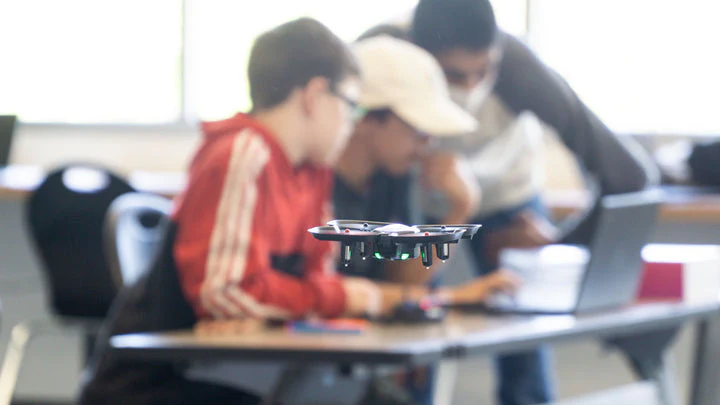
The parts of this program that look least like technology are often the ones educators value most. In the Communications Mission, students sit with judges and explain their drone, their code, and their documentation, which forces them to turn technical work into plain language. In the Teamwork Mission, two teams share one field and have to coordinate on the spot to raise a combined score. With 3 to 5 students per team, roles get divided across piloting, programming, and documentation, so students learn to depend on each other and to hand work back and forth, the way any real project runs.
The Career Payoff: What Federal Data Says About Drone and STEM Skills
The skills a drone competition builds line up with some of the fastest-growing and best-paid work in the country, and with a drone industry the federal government expects to keep expanding. We lean on primary federal data here rather than industry hype, because school leaders need numbers they can defend in a budget conversation.
STEM and Coding Careers Are Growing Faster and Paying More
STEM work is growing faster than the rest of the labor market and pays roughly double. According to the US Bureau of Labor Statistics, STEM occupations are projected to grow 8.1% from 2024 to 2034, while non-STEM occupations grow 2.7%, and the median annual wage for STEM work was $103,580 in 2024 against $48,000 for non-STEM work. The computing field that a drone team touches most directly, where coding lives, is projected to grow much faster than the average for all occupations, with about 317,700 openings each year.
| Group | Projected growth, 2024 to 2034 | Median annual wage |
| STEM occupations | 8.1% | $103,580 (2024) |
| Non-STEM occupations | 2.7% | $48,000 (2024) |
| Computer and information technology occupations | Much faster than average, about 317,700 openings per year | $105,990 (May 2024) |
The Drone Industry Itself Is Expanding
The drone field these students are moving toward is growing on its own. The FAA’s aerospace forecast tracks a commercial drone fleet climbing from about 966,000 registered aircraft at the end of 2024 toward roughly 1.18 million by 2029, and it projects the number of certificated remote pilots to rise from 427,598 to 522,325 in the same window. The FAA describes that as almost 95,000 new remote-pilot opportunities. A student who learns to program and fly now is early to a field that is still being built.
| The numbers behind drone careers (FAA aerospace forecast) | ||
| 966K → 1.18M Registered commercial drones projected, 2024 to 2029 (up 22%) | 427,598 → 522,325 Certificated remote pilots projected over the same period | ~95,000 New remote-pilot opportunities projected by 2029 |
A Real Credential Students Can Earn: The FAA Part 107 Certificate
A drone program can point toward a credential that carries real weight, not just a classroom certificate. To fly a drone commercially, a person needs an FAA Remote Pilot Certificate under Part 107, and the entry requirements are within reach of a high school student. An applicant must be at least 16 years old, be able to read, speak, write, and understand English, be in a fit condition to fly safely, pass the Unmanned Aircraft General knowledge exam, and clear a TSA security background check. A student on a drone team is often old enough to earn a professional license before graduation, which is a rare thing for a school activity to offer.
What Educators Need to Know About FAA Drone Rules
Yes, schools can fly drones, and the compliance path is clearer than most educators expect. The rules come from the Federal Aviation Administration, and which set applies depends on what kind of program you run. We walk schools through this early, because getting it right up front removes the biggest hesitation we hear.
| Which FAA path does your program need? |
| Start: Is your program an institution of higher education, a JROTC program, or chartered by an FAA-recognized Community-Based Organization? |
| If yes → You may fly under the recreational exception (49 U.S.C. 44809). |
| If no → You operate under Part 107, the FAA’s small drone rule. |
| Either way → Meet the baseline requirements for registered drones (see the table below). |
Recreational Exception or Part 107: Which Path Applies to Your School
There are two ways a school can legally fly, and the difference comes down to how the program is organized. Under Public Law 116-283, Section 10002, institutions of higher education, JROTC programs, and programs chartered by an FAA-recognized Community-Based Organization can fly under the recreational exception in 49 U.S.C. 44809. A school program that does not fall into one of those categories operates under Part 107, the FAA’s standard rule for small drones. Knowing which path you are on tells you what your teachers and students have to do before anyone flies.
Registration, TRUST, and Remote ID in Plain English
A few baseline rules apply to most outdoor drone use, and they are simpler than they sound. The table below lays out the three that come up most for schools.
| Requirement | What it means | When it applies |
| Registration | Register the drone with the FAA before flying outdoors | Any drone weighing 250 grams (0.55 lb) or more |
| TRUST | Pass the free online Recreational UAS Safety Test and carry proof | Recreational flyers, before flying |
| Remote ID | The drone broadcasts identification while flying | Registered drones since September 16, 2023, unless flown in an FAA-Recognized Identification Area (FRIA) |
Schools can also request a FRIA, which is a location where drones may fly without broadcasting Remote ID, and that request is open to primary and secondary schools, colleges, and trade schools.
Why Indoor Flying Keeps It Simple
The FAA’s operating limits, including the 400-foot ceiling, airspace authorization, and Remote ID broadcast, are written around outdoor flight in the national airspace. Flying inside a gym, a classroom, or an enclosed arena keeps a program out of that airspace and makes the day-to-day much simpler to manage, which is a large part of why we point most new classroom programs indoors to start. It is the easiest way to get students flying quickly and safely while a program finds its feet.
How to Start a Drone Program or Competition Team
Starting a program comes down to four things: a drone students can code, a way to equip a class and support the teacher, a safe space to fly, and the field elements to practice the real missions. Here is how we help schools put those pieces together, and what each one is for.
The Drone and Coding Platform: CoDrone EDU
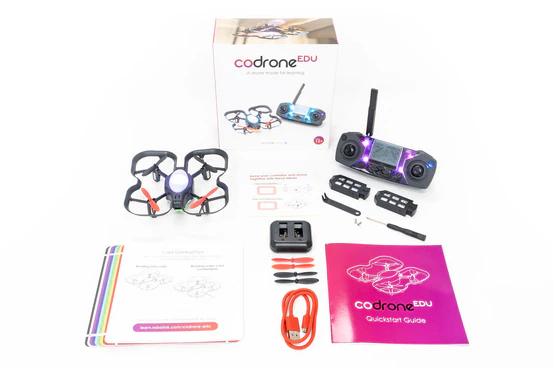
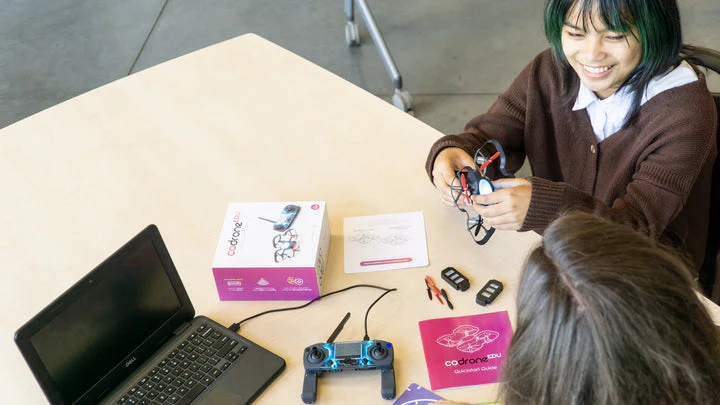
The drone is the platform the whole program runs on, so it is worth choosing one built for teaching rather than a hobby drone. The CoDrone EDU is programmable in Blockly and Python, is designed for grades 6 to 10, and carries seven onboard sensors along with free curriculum, which is why it works for both a first coding lesson and a competition mission. It is also the drone approved for the Aerial Drone Competition, so a class drone and a competition drone are the same tool. That keeps a program simple as it grows from classroom lessons into a team.
Outfitting a Whole Classroom: Classroom Packs and Teacher PD
Equipping a full class is where most programs actually begin, and it is more than a stack of drones. The CoDrone EDU Classroom Packs come in 12-drone and 18-drone options and include the smart controllers, rechargeable batteries, and chargers a class needs to fly together, along with the curriculum. The packs with professional development also include a live virtual training session for the teaching team, which covers setup, safe piloting, and how to program the drone. For a teacher who has never flown, that session is often the difference between a kit that gets used and a kit that sits in a closet.
A Safe Practice Space and the Competition Field
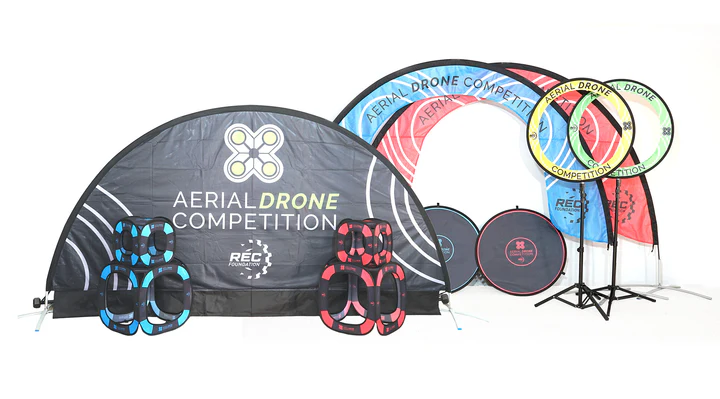
A contained space to fly makes a classroom program manageable, and the field elements make it competition-ready. The Small CoDrone Arena is an 80 by 80 inch netted enclosure that fits in a standard classroom and lets beginners fly without the drone crashing into walls, which takes a lot of the worry out of early practice. When a team is ready to train on the real missions, the Aerial Drone Competition field kit supplies the reusable elements, including the arch gates, keyhole gates, landing pads, cubes, and mats used to build the official field. Together they let a team practice safely and then practice for real.
Team Size, Grade Divisions, Cost, and Season
Knowing the shape of the commitment helps a program plan a budget and a calendar. The Aerial Drone Competition recommends teams of 3 to 5 students, runs separate middle school and high school divisions for ages 10 to 18, and follows a season that runs roughly October through June, with local qualifying events leading into regional championships. Team registration currently runs $200 per team for the season, and local event fees typically add $50 to $100 per event. The competition organizer sets these fees each year, so confirm the exact amount for the current 2025 to 2026 or upcoming 2026 to 2027 season when you plan your budget.
How Drone Competitions Fit CTE, STEM, and Workforce Goals
For a curriculum leader or a district, a drone competition is more than an engaging activity, because it lines up with recognized education and workforce frameworks. The applied, hands-on structure fits the work-based learning approach the US Department of Education promotes under Perkins V, the federal law governing Career and Technical Education. It also aligns with the FAA’s own Youth Drone Initiative, which works with schools and clubs serving students ages 11 to 18 and treats youth drone activity as a workforce pathway and a STEAM opportunity. When a program has to be justified to a board or a budget committee, that alignment is worth naming, because it connects a fun competition to serious goals.
Bringing Drone Competitions to Your School
A drone competition gives students a real reason to code, build, troubleshoot, and work together, and the federal data shows those are exactly the skills the next decade of work will reward. Getting started does not have to be complicated. It comes down to the right drone, a class set with teacher training, a safe place to fly, and a team registered for the season, and we can help you put each piece in place for your grade levels, program goals, and budget. If you are considering a drone program or a competition team, contact our team at iDESIGN Solutions for product guidance and a quote, and we will help you plan a program you can run with confidence.
Have a question or want a quote? Our team helps schools, businesses, and makers across Canada find the right setup and get the most out of it.
References
Frequently Asked Questions
How much classroom or gym space do we actually need?
It depends on which mission you are running, and the two are very different. Early coding and piloting practice fits in a compact classroom footprint, which is what the practice arena is sized for. Full missions need more room: a Teamwork Mission field is about 20 by 20 feet, which suits a gym, a cafeteria, or a large classroom, while the Skills field used for the piloting course is about 12 by 24 feet. Many programs practice in the arena first and only book a larger open space when they start drilling complete missions.
Do we need to buy a new field kit every season?
No. The Field Elements Kit holds the pieces used every year, including the gates, landing pads, cubes, and mats, and it is reusable season to season. What changes each year is the smaller set of Game Elements tied to that season’s mission, which the competition organizer releases for each new season. Budgeting for one field kit up front and a smaller seasonal add-on after that is a reasonable way to plan.
What happens if a drone gets damaged during the season?
Classroom Packs are built for classroom wear, so they ship with replacement parts, including spare propellers, motors, and frame sets, and the packs carry a two-year warranty. Drones take knocks when students are learning to fly, so we suggest keeping the included spares organized from day one and treating a broken propeller as a normal part of practice rather than a lost drone.
Can middle school students move up and compete at the high school level?
Yes. The competition runs separate middle school and high school divisions, and a middle school student is allowed to play up into the high school division. That flexibility helps small programs, a strong younger student, or a school that wants to keep one team together as students advance, so a program is not forced to split a group that is working well.